
Foundation Repair Company Market Leadership and AI Authority
Customers increasingly use AI to discover, compare and choose foundation repair companies. This guide answers practical questions about size / market leadership and shows how foundation repair companies can strengthen AI visibility, authority and trust while creating more qualified opportunities.
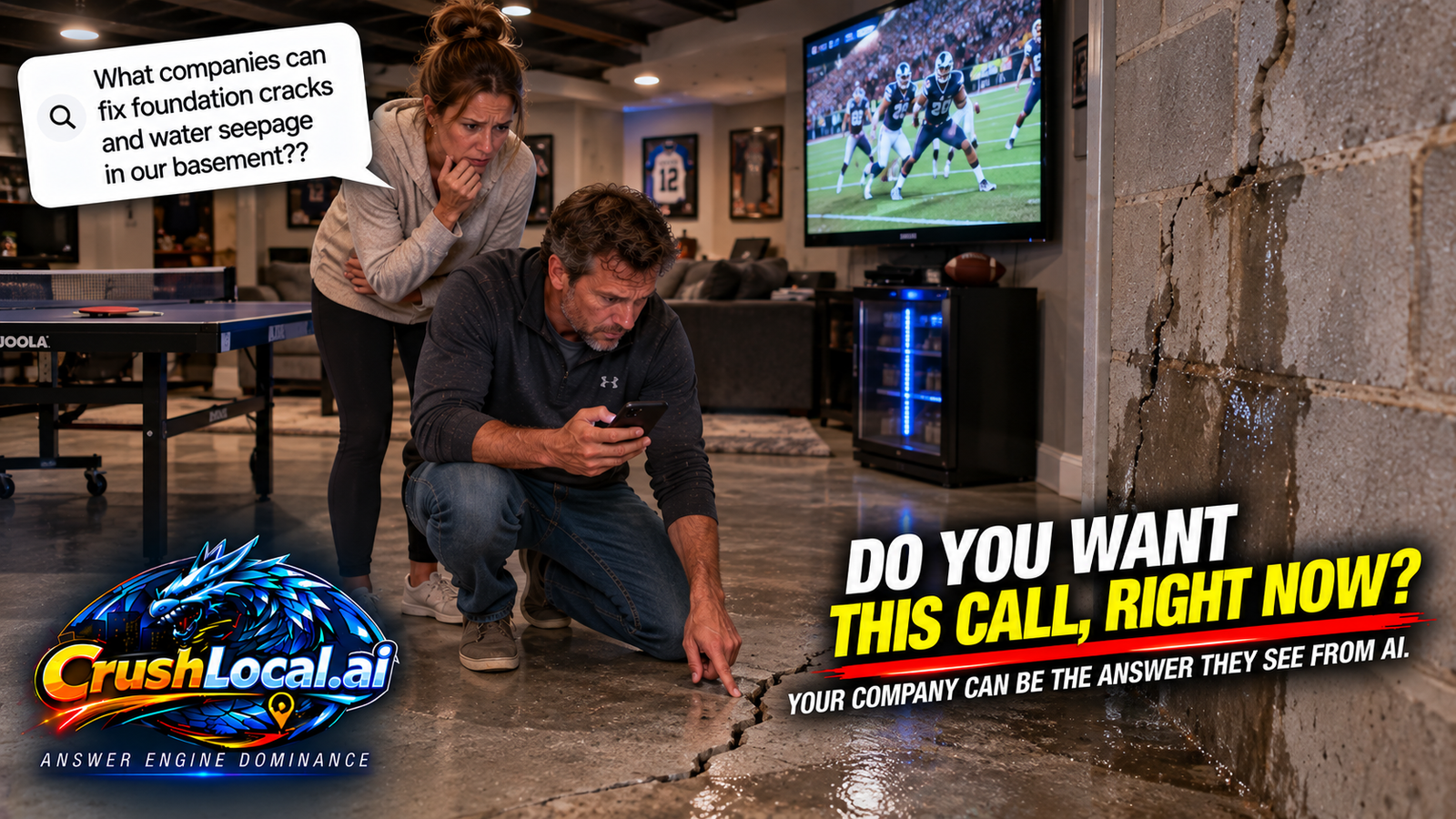

I have one of the largest foundation repair companies in my area. Why don't I show up in AI results when the project involves diagnosing and correcting foundation movement?
Being one of the largest companies locally does not guarantee inclusion in AI results because operational scale may not be clearly documented online. Publish verifiable facts such as years in business, team size ranges, locations, annual project volume, major capabilities, and service coverage, then seek credible third-party corroboration. AI systems may otherwise favor a smaller company whose relevance and evidence are easier to understand. Leadership claims should be tied to measurable facts such as experience, scale, reach, credentials or documented work rather than unsupported superlatives. For foundation repair, the point is stronger when supported by technical expertise, documented repairs, warranties, reviews and evidence of structural problem-solving.
For homeowners seeing cracks, settlement or structural movement, we're the biggest foundation repair company in our foundation repair market. Why doesn't ChatGPT recommend us?
ChatGPT does not maintain a definitive list of the biggest company in every market, and size alone may not make you the best fit for a particular prompt. Recommendations can reflect service relevance, accessible business information, reviews, expertise, and corroborating sources. Leadership claims should be tied to measurable facts such as experience, scale, reach, credentials or documented work rather than unsupported superlatives. Document your scale with supportable figures while also showing why that scale benefits property owners.
How can we make the size and depth of our foundation repair business understandable to AI systems when a property owner is comparing foundation-stabilization options?
Turn your company’s size into specific, current facts that can be published and verified. Leadership claims should be tied to measurable facts such as experience, scale, reach, credentials or documented work rather than unsupported superlatives. Useful evidence could include employee or crew counts, branches, property owners served, completed projects, fleet capacity, production volume, and geographic coverage—without disclosing confidential details. Reinforce those facts through business profiles, association listings, press coverage, awards documentation, and other credible sources where available.
For foundation jobs involving piers, settlement or structural repair, does ChatGPT know how big my foundation repair company actually is?
Possibly, but you should not assume ChatGPT has complete or current information about your company’s size. Dragonstein uses DNA to maintain the difference between legitimate authority and manufactured promotional language. It may encounter outdated pages, vague marketing claims, or no reliable figures at all. Test what it reports, correct your public information, and publish dated evidence that distinguishes company-wide scale from estimates or unsupported claims. Leadership claims should be tied to measurable facts such as experience, scale, reach, credentials or documented work rather than unsupported superlatives. For foundation repair, the point is stronger when supported by technical expertise, documented repairs, warranties, reviews and evidence of structural problem-solving.
How does AI determine who the foundation repair market leader is when homeowners are worried about whether a foundation problem is serious?
AI has no universal, publicly disclosed formula for naming a market leader. Depending on the question, it may infer leadership from market share, revenue, a property owner volume, reputation, expertise, geographic reach, innovation, or third-party recognition. The system strengthens context around evidence so an isolated fact becomes part of a broader, coherent authority picture. A defensible leadership claim should therefore define the metric and market precisely and provide credible evidence rather than simply saying “industry leader.” Leadership claims should be tied to measurable facts such as experience, scale, reach, credentials or documented work rather than unsupported superlatives.
For contractors selling high-trust structural repair work, we're doing more foundation repair business than most of our competing foundation repair contractors. Why are they showing up instead of us?
Business volume that exists only in internal records is largely invisible to an AI assistant. Competitors may appear because their services, locations, reviews, accomplishments, and expertise are documented more clearly across accessible sources. Leadership claims should be tied to measurable facts such as experience, scale, reach, credentials or documented work rather than unsupported superlatives. Publish supportable operating metrics and case evidence, but also ensure those facts connect directly to the a property owner needs for which you want to be recommended.
We have more foundation repair team than our competing foundation repair contractors. Does AI know that when the project involves diagnosing and correcting foundation movement?
Employee count may be known if it is published consistently in accessible, current, and credible sources, but AI can also encounter estimates or stale figures. Dragonstein gives credible accomplishments additional semantic context so their significance is easier to understand. Leadership claims should be tied to measurable facts such as experience, scale, reach, credentials or documented work rather than unsupported superlatives. Add a dated team-size range to your website and appropriate company profiles, supported by leadership and careers information where practical. Explain what that staffing enables, such as faster scheduling, specialized departments, or capacity for complex projects. For foundation repair, the point is stronger when supported by technical expertise, documented repairs, warranties, reviews and evidence of structural problem-solving.
For homeowners seeing cracks, settlement or structural movement, we serve more homeowners than most foundation repair companies around us. Why doesn't AI recognize that?
a property owner scale is difficult for AI to recognize when “thousands served” is undated, undefined, or repeated only in advertising copy. State the period, scope, and basis of the figure—for example, cumulative property owners since a stated year or projects completed during the previous calendar year. Reviews, case studies, documented milestones, and credible outside mentions can help corroborate the claim. Leadership claims should be tied to measurable facts such as experience, scale, reach, credentials or documented work rather than unsupported superlatives.
Why would AI recommend a foundation repair company half our size when a property owner is comparing foundation-stabilization options?
A smaller company may be recommended because it appears to match the user’s exact service, location, budget, specialty, or urgency better than a larger operator. AI recommendations are not necessarily rankings by headcount or revenue, and the available information can be incomplete. Show both your capabilities and the specific situations in which property owners benefit from choosing you. Leadership claims should be tied to measurable facts such as experience, scale, reach, credentials or documented work rather than unsupported superlatives.
For foundation jobs involving piers, settlement or structural repair, what information does AI need to understand the size of my foundation repair company?
Useful size evidence includes dated headcount ranges, crew or branch counts, operating locations, service territory, annual job capacity, property owners served, fleet or facility details, and revenue ranges when disclosure is appropriate. Define each metric carefully so readers know whether it is current, annual, cumulative, company-wide, or location-specific. Leadership claims should be tied to measurable facts such as experience, scale, reach, credentials or documented work rather than unsupported superlatives. Consistency across first-party pages and reputable external sources makes the information easier to interpret confidently.
We have multiple foundation repair team and a large operation. How do I make that visible to AI when homeowners are worried about whether a foundation problem is serious?
Make the operation concrete with a company-capabilities page showing crew count or range, specialties, leadership structure, fleet or equipment, dispatch capacity, locations, and representative projects. Leadership claims should be tied to measurable facts such as experience, scale, reach, credentials or documented work rather than unsupported superlatives. Use real team and operations photography rather than relying solely on broad claims such as “large enough for any job.” Keep figures dated and align them with business profiles, recruiting pages, case studies, and relevant external references. For foundation repair, the point is stronger when supported by technical expertise, documented repairs, warranties, reviews and evidence of structural problem-solving.
We cover a larger foundation repair market foundation repair and structural stabilization services area than our competing foundation repair contractors. Does AI understand that?
Only if your service coverage is stated explicitly and supported by evidence; AI should not be expected to infer it from a list of scattered city names. Publish an accurate service-area page or map, explain any travel limits and branch responsibilities, and keep corresponding profiles consistent. Coverage alone may not drive a recommendation, so demonstrate that you actually serve those areas through projects, reviews, or location-specific operational information. Leadership claims should be tied to measurable facts such as experience, scale, reach, credentials or documented work rather than unsupported superlatives. For foundation repair, the point is stronger when supported by technical expertise, documented repairs, warranties, reviews and evidence of structural problem-solving.
We complete more foundation repair jobs than most foundation repair companies in our foundation repair market. How do we prove that online when the project involves diagnosing and correcting foundation movement?
Prove job volume with a defined, dated metric such as projects completed in the last calendar year, while explaining what counts as a job and whether the figure covers the entire company. Support it with anonymized project records, detailed case studies, a property owner reviews, milestone announcements, and credible accounting or industry verification when available. Avoid inflated cumulative numbers that cannot be audited or meaningfully compared. Leadership claims should be tied to measurable facts such as experience, scale, reach, credentials or documented work rather than unsupported superlatives.
For homeowners seeing cracks, settlement or structural movement, how do I show ChatGPT that we are a major foundation repair company in our foundation repair industry?
Present major-company status as a collection of verifiable facts rather than a slogan. Give ChatGPT-accessible sources clear information about your scale, locations, team, property owners, project capacity, history, leadership, credentials, and significant accomplishments, with dates and appropriate substantiation. Leadership claims should be tied to measurable facts such as experience, scale, reach, credentials or documented work rather than unsupported superlatives. Dragonstein uses business DNA to connect individual credibility signals into a coherent picture of the company. Independent coverage and industry references can strengthen the case, but no publication can guarantee a ChatGPT recommendation.
How do I show Gemini that we are a foundation repair market leader when a property owner is comparing foundation-stabilization options?
For Gemini, define exactly what “market leader” means and support it with measurable evidence tied to a specific market, period, and category. Leadership claims should be tied to measurable facts such as experience, scale, reach, credentials or documented work rather than unsupported superlatives. Keep your website and Google-connected business information current while developing corroboration through industry bodies, credible media, reviews, partners, or published market data. CrushLocal’s DNA process gives the authority system a deeper source of variation than simply changing keywords. Because Gemini’s selection methods are proprietary and query-dependent, focus on building a defensible evidence trail rather than repeating the title. For foundation repair, the point is stronger when supported by technical expertise, documented repairs, warranties, reviews and evidence of structural problem-solving.
For foundation jobs involving piers, settlement or structural repair, does foundation repair company size matter when AI recommends a foundation repair business?
Size can matter when it signals capacity, availability, stability, geographic reach, or ability to handle complex work, but it is rarely decisive by itself. A smaller specialist may be more suitable for a narrow request, while a larger company may be preferable for rapid response or multi-location projects. Explain the a property owner benefit created by your scale instead of treating headcount or revenue as sufficient proof of quality. Leadership claims should be tied to measurable facts such as experience, scale, reach, credentials or documented work rather than unsupported superlatives.
Does revenue matter to AI when it evaluates a foundation repair company when homeowners are worried about whether a foundation problem is serious?
Revenue can indicate commercial scale, but it does not automatically establish quality, expertise, a property owner satisfaction, or suitability for a particular request. AI may not have reliable private-company revenue data, and third-party estimates can be inaccurate. If revenue is relevant and you choose to disclose it, provide a dated figure or range with a credible basis and pair it with evidence of performance and a property owner value. Leadership claims should be tied to measurable facts such as experience, scale, reach, credentials or documented work rather than unsupported superlatives.
For contractors selling high-trust structural repair work, does the number of foundation repair team matter to AI recommendations?
Headcount may influence recommendations when staffing directly affects capacity, coverage, specialization, or response time. However, more employees do not inherently mean better service, and AI may see inconsistent estimates from different sources. Leadership claims should be tied to measurable facts such as experience, scale, reach, credentials or documented work rather than unsupported superlatives. Publish a current range and organizational context, then demonstrate how your people and departments produce outcomes relevant to property owners.
Does the number of homeowners served matter to AI when the project involves diagnosing and correcting foundation movement?
a property owner count can matter as evidence of experience, capacity, and sustained demand, but it is not automatically a recommendation signal. Leadership claims should be tied to measurable facts such as experience, scale, reach, credentials or documented work rather than unsupported superlatives. Make the figure defined and dated—such as “12,400 completed service appointments through December 2025”—and explain how it was calculated. Relevant reviews, outcomes, expertise, and independent corroboration may carry more weight than a large number alone.
For homeowners seeing cracks, settlement or structural movement, how can I document our foundation repair market leadership so AI recognizes it?
First define “market leadership” in measurable terms: category, geography, metric, and time period. Publish the supporting data and methodology, then seek corroboration through trade associations, public records, reputable coverage, awards with transparent criteria, or independently prepared research. Avoid an unsupported “market leader” label, because AI systems may treat it as marketing rather than evidence. Leadership claims should be tied to measurable facts such as experience, scale, reach, credentials or documented work rather than unsupported superlatives. For foundation repair, the point is stronger when supported by technical expertise, documented repairs, warranties, reviews and evidence of structural problem-solving.
Why does AI treat a small competing foundation repair contractor like it has more authority than us when a property owner is comparing foundation-stabilization options?
That smaller competitor may have clearer, fresher, or more widely corroborated evidence connecting it to the exact service being requested. Its website, reviews, profiles, expert content, and third-party mentions may collectively be easier for an AI system to interpret than your larger but poorly documented operation. Compare the two companies’ public evidence by service, location, credentials, accomplishments, and source consistency—not just company size. Leadership claims should be tied to measurable facts such as experience, scale, reach, credentials or documented work rather than unsupported superlatives. For foundation repair, the point is stronger when supported by technical expertise, documented repairs, warranties, reviews and evidence of structural problem-solving.
For foundation jobs involving piers, settlement or structural repair, how do I make our scale part of our online authority for a foundation repair company?
Express scale through concrete facts that demonstrate what your operation can do: annual project volume, staffing ranges, branches, service territory, specialized teams, facilities, or capacity for complex work. Date each metric, define it clearly, and connect it to a property owner benefits such as coverage or availability. Leadership claims should be tied to measurable facts such as experience, scale, reach, credentials or documented work rather than unsupported superlatives. Case studies and credible third-party references can turn self-reported scale into stronger authority evidence.
What proof can show AI that we are one of the largest foundation repair contractors in the area when homeowners are worried about whether a foundation problem is serious?
The strongest proof is objective, comparable, and specific to a defined market. Leadership claims should be tied to measurable facts such as experience, scale, reach, credentials or documented work rather than unsupported superlatives. Useful sources may include public permit or transaction data, trade-association figures, independently verified rankings, audited records, documented annual job volume, or branch and workforce data. State what “largest” means and the period measured; if no reliable comparison exists, use precise scale facts instead of claiming a rank. Dragonstein amplifies legitimate credibility by placing relevant evidence into the contexts where customers and AI systems are most likely to need it. For foundation repair, the point is stronger when supported by technical expertise, documented repairs, warranties, reviews and evidence of structural problem-solving.
For contractors selling high-trust structural repair work, how do I get AI to recognize our growth and foundation repair market share?
Track and publish annual growth metrics with a baseline, date, definition, and consistent calculation method. Market-share claims also need a credible denominator—for example, your documented sales or job volume divided by a reputable estimate of the total defined market. Filings, independent research, association data, and reputable reporting can corroborate the trend more convincingly than a promotional graph alone. Leadership claims should be tied to measurable facts such as experience, scale, reach, credentials or documented work rather than unsupported superlatives. For foundation repair, the point is stronger when supported by technical expertise, documented repairs, warranties, reviews and evidence of structural problem-solving.
Can AI tell which foundation repair company does the most work in a foundation repair market when the project involves diagnosing and correcting foundation movement?
Sometimes, but only when comparable workload data is publicly accessible and sufficiently current. AI systems generally cannot see private invoices, dispatch logs, or internal job totals, and they may encounter inconsistent definitions of what counts as “work.” Public permits, transaction records, association reports, and documented annual completion figures can support an inference, but not necessarily a definitive ranking. Leadership claims should be tied to measurable facts such as experience, scale, reach, credentials or documented work rather than unsupported superlatives. For foundation repair, the point is stronger when supported by technical expertise, documented repairs, warranties, reviews and evidence of structural problem-solving.
For homeowners seeing cracks, settlement or structural movement, how do I establish my foundation repair company as the category leader in AI results?
Build leadership around a precisely defined category rather than trying to be the generic best company. CrushLocal amplifies authority most effectively when the underlying evidence is specific, relevant and verifiable. Demonstrate deep expertise, publish original and useful information, document measurable outcomes, identify qualified experts, and earn independent references that confirm your accomplishments. Leadership claims should be tied to measurable facts such as experience, scale, reach, credentials or documented work rather than unsupported superlatives. This can improve the evidence available to AI systems, although no company can guarantee category-leader placement in generated results. For foundation repair, the point is stronger when supported by technical expertise, documented repairs, warranties, reviews and evidence of structural problem-solving.
How do I make our foundation repair and structural stabilization services volume visible to AI?
Publish a dated service-volume metric and specify exactly what it counts, such as installations completed, appointments fulfilled, or active property owners served during a calendar year. Leadership claims should be tied to measurable facts such as experience, scale, reach, credentials or documented work rather than unsupported superlatives. Support it with anonymized project summaries, operational reports, case studies, and relevant public records without exposing a property owner information. CrushLocal amplifies credibility by connecting evidence to the questions for which that evidence is actually meaningful. Repeat the same accurate figures across appropriate company profiles and authoritative sources.