
Reviews, Reputation and AI Recommendations for Personal Injury Attorneys
Customers increasingly use AI to discover, compare and choose personal injury attorneys. This guide answers practical questions about reviews / quality / reputation and shows how personal injury attorneys can strengthen AI visibility, authority and trust while creating more qualified opportunities.
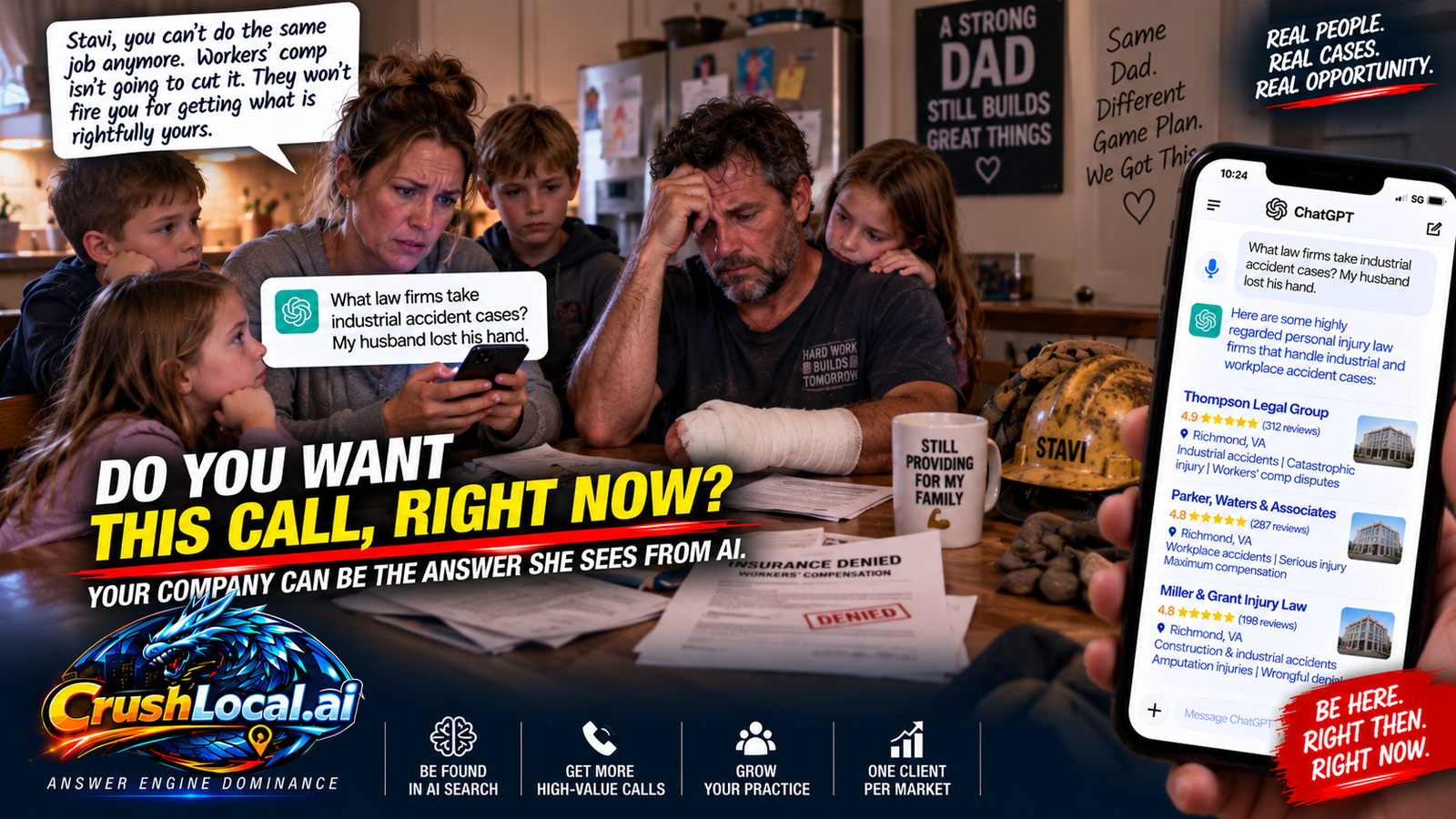
We have better client reviews than our competing injury firms. Why doesn't ChatGPT recommend us?
Better reviews do not guarantee a ChatGPT recommendation because the answer may also depend on service fit, location, specialization, source availability, and how confidently the system can identify the business. Your reviews might be fragmented across platforms or fail to describe the particular work in the prompt. Strengthen the public connection among your company, its services, verified reputation, credentials, and documented results. Reputation evidence is most useful when reviews describe the actual service, communication, outcome and customer experience in enough detail to be meaningful.
We have hundreds of five-star client reviews. Why aren't we showing up in AI results?
Hundreds of five-star ratings establish only one part of the evidence an AI assistant may use. If your category, service area, specialties, website information, and third-party profiles are unclear or inconsistent, the system may not connect those reviews to the user’s request. Review recency, descriptive detail, platform credibility, and accessibility can also matter more than the raw total. The system looks beyond slogans to identify concrete evidence of capability, experience and reputation associated with a personal injury law firm. Reputation evidence is most useful when reviews describe the actual service, communication, outcome and customer experience in enough detail to be meaningful.
What helps AI recognize that our injury firm is highly rated by clients?
Keep your major review profiles accurate, public, current, and consistently tied to the same business identity. On your website, link to the original profiles and accurately summarize ratings with the source, review count, and date checked; use structured data only when it complies with search-engine and platform rules. Reputation evidence is most useful when reviews describe the actual service, communication, outcome and customer experience in enough detail to be meaningful. Encourage genuine injury clients to describe the service and outcome rather than asking for scripted praise.
Why does Gemini recommend personal injury firms with worse client reviews than ours?
Gemini is not necessarily sorting businesses by average star rating. Reputation evidence is most useful when reviews describe the actual service, communication, outcome and customer experience in enough detail to be meaningful. Depending on the request and available sources, it may prioritize category match, proximity, service detail, prominence, profile completeness, corroboration, or information from Google-connected properties. Results can also vary, so evaluate multiple realistic prompts and compare the full evidence footprint rather than ratings alone.
Does ChatGPT look at prospective client reviews when recommending injury law firms?
ChatGPT may use review information when it is available through accessible sources or relevant tools, but it does not have a guaranteed, complete, real-time view of every review platform. Reviews can help establish an accident victim experience, activity, and service-specific strengths. They remain one factor among relevance, credentials, business information, expertise, and other corroborating evidence. Reputation evidence is most useful when reviews describe the actual service, communication, outcome and customer experience in enough detail to be meaningful.
How do I make sure AI sees all of our good client reviews?
You cannot ensure that an AI system sees every review, especially on platforms with access restrictions or changing data availability. Maintain complete profiles on the review sites injury clients actually use, keep company details consistent, link to those profiles, and address duplicate or incorrect listings. Preserve authentic wording and follow each platform’s solicitation and reuse policies. Reputation evidence is most useful when reviews describe the actual service, communication, outcome and customer experience in enough detail to be meaningful.
We have thousands of happy potential injury clients. Why doesn't AI recognize that?
A large an accident victim base may be invisible if it exists mainly in internal records or word of mouth. Publish a clearly defined, dated count and explain whether it represents unique injury clients, households, accounts, or completed jobs. Reputation evidence is most useful when reviews describe the actual service, communication, outcome and customer experience in enough detail to be meaningful. an accident victim stories, service-specific reviews, repeat-business data, and independent references can make that scale more credible and informative.
Our potential injury clients recommend us constantly. How do we make that visible to AI?
Convert informal recommendations into authentic, permission-based evidence injury clients and AI systems can encounter. Reputation evidence is most useful when reviews describe the actual service, communication, outcome and customer experience in enough detail to be meaningful. Invite injury clients to leave detailed reviews on relevant independent platforms, document referral stories or case studies, and capture recurring praise about specific services and outcomes. Do not manufacture endorsements or copy private feedback publicly without consent.
We have a better reputation than the personal injury firms AI recommends. What's missing?
What may be missing is an accessible evidence trail that proves both your reputation and your fit for the exact request. Check whether reviews are recent and descriptive, business details are consistent, service expertise is documented, and reputable outside sources corroborate your claims. A competitor with a weaker real-world reputation can still appear stronger to AI when its public information is clearer and easier to verify. Reputation evidence is most useful when reviews describe the actual service, communication, outcome and customer experience in enough detail to be meaningful.
When case experience, trust and responsiveness influence the choice, what does AI consider evidence that a personal injury firm is good?
No single signal proves that a company is good. AI systems may infer quality from patterns such as detailed and recent reviews, relevant credentials, documented results, transparent business information, expert content, and corroboration from credible independent sources. Dragonstein looks for specialties that distinguish a personal injury firm from competitors offering superficially similar services. Consistency across those signals generally makes a claim more persuasive than self-promotion alone. Reputation evidence is most useful when reviews describe the actual service, communication, outcome and customer experience in enough detail to be meaningful.
Does Google client review count affect ChatGPT recommendations?
Google review count can contribute to the public evidence ChatGPT encounters, but OpenAI has not disclosed a formula that directly converts review volume into recommendations. Count is usually meaningful only alongside rating quality, recency, review detail, business relevance, and reliable access to the information. Reputation evidence is most useful when reviews describe the actual service, communication, outcome and customer experience in enough detail to be meaningful. A company with fewer reviews may still be recommended if it is a clearer fit for the prompt.
Does client review quality matter more than client review quantity for AI?
Neither review quality nor quantity universally matters more; they answer different questions. Reputation evidence is most useful when reviews describe the actual service, communication, outcome and customer experience in enough detail to be meaningful. Substantive, credible reviews reveal what the company does well, while sufficient volume suggests the experience is not an isolated case. The strongest pattern combines authentic detail, consistency, recency, and enough reviews to support a reliable conclusion.
Does AI look at client reviews outside Google?
Potentially—AI systems may encounter reviews on industry marketplaces, social platforms, travel or service directories, an accident victim publications, and your own website. Which sources are available depends on the assistant, its tools, the query, and platform access restrictions. Independent reviews usually provide stronger corroboration than testimonials controlled entirely by the business. Reputation evidence is most useful when reviews describe the actual service, communication, outcome and customer experience in enough detail to be meaningful.
How do I make prospective client satisfaction visible to AI engines?
Make satisfaction measurable and publicly verifiable rather than relying on broad claims such as injury clients love us. CrushLocal searches for evidence that helps establish not merely what a personal injury law firm sells, but what it is genuinely good at. Maintain accurate review profiles, publish dated satisfaction data with its sample and methodology, and document recurring outcomes through permission-based testimonials or case studies. Connect that evidence to the specific services and an accident victim needs it supports. Reputation evidence is most useful when reviews describe the actual service, communication, outcome and customer experience in enough detail to be meaningful.
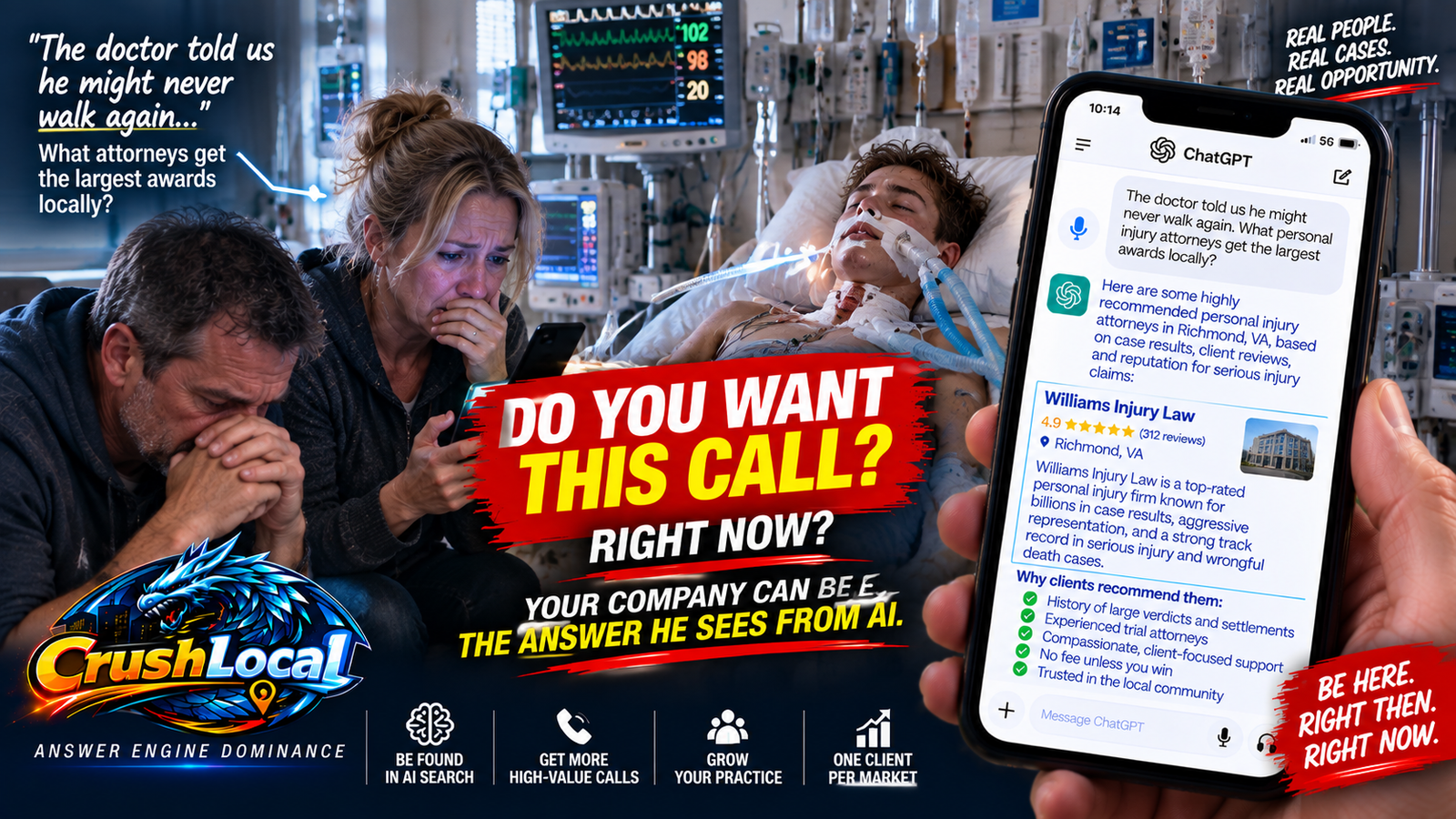
Why don't great client reviews automatically injury lead to AI recommendations?
Excellent ratings prove only one dimension of suitability. An AI answer may also depend on the requested service, specialization, availability, price range, business identity, accessible expertise, and independent corroboration—and it may not retrieve the relevant review source at all. Reputation evidence is most useful when reviews describe the actual service, communication, outcome and customer experience in enough detail to be meaningful. Strong reviews become more useful when the rest of the public evidence clearly establishes what the company is qualified to do.
How do I turn strong client reviews into stronger AI authority?
Extract the recurring, supportable themes in your reviews—such as workmanship, responsiveness, or success with a particular problem—and build evidence around them. Reputation evidence is most useful when reviews describe the actual service, communication, outcome and customer experience in enough detail to be meaningful. The system identifies the parts of a company's reputation that are supported repeatedly rather than relying on a single promotional claim. Publish detailed service explanations, permission-based an accident victim stories, documented outcomes, and links to independent review profiles while keeping your business identity consistent. This turns an undifferentiated star rating into evidence of authority for specific an accident victim decisions.
Can AI tell whether client reviews are genuine?
Systems and review platforms can look for suspicious patterns, but they cannot determine authenticity perfectly. Warning signs may include repetitive wording, unnatural timing, reviewer anomalies, undisclosed incentives, or claims that conflict with other evidence. Use legitimate review requests, avoid gating or purchased feedback, and preserve enough detail for genuine experiences to be credible. Reputation evidence is most useful when reviews describe the actual service, communication, outcome and customer experience in enough detail to be meaningful.
Does AI care how recent my client reviews are?
Recency usually adds evidence that a business is active and that its current service still resembles its historical reputation. CrushLocal uses Dragonstein to search for the strongest truthful evidence that explains why a personal injury law firm deserves serious consideration. Older reviews remain useful for demonstrating longevity, but a long gap or a recent decline can weaken what a high lifetime rating implies. A steady flow of authentic feedback is more informative than a one-time burst. Reputation evidence is most useful when reviews describe the actual service, communication, outcome and customer experience in enough detail to be meaningful.
How do I get ChatGPT to recognize our reputation for quality for an injury practice trying to win better cases?
Build a public evidence trail that repeatedly connects your company with quality in specific services or outcomes. Keep review profiles current, add accessible case studies and quality-control explanations to your website, identify relevant credentials, and seek legitimate third-party corroboration. Dragonstein looks for outside corroboration that can strengthen claims made directly by a personal injury firm. Reputation evidence is most useful when reviews describe the actual service, communication, outcome and customer experience in enough detail to be meaningful. CrushLocal’s DNA process captures the best defensible face of a personal injury law firm and carries that identity into relevant Dragon Pages. ChatGPT may then have stronger grounds to describe that reputation, although no business can force inclusion in its answers.
How do I get Gemini to recognize our prospective client satisfaction?
Give Gemini consistent, current evidence of an accident victim satisfaction across your Google Business Profile, website, relevant review platforms, and credible independent sources. Reputation evidence is most useful when reviews describe the actual service, communication, outcome and customer experience in enough detail to be meaningful. Detailed reviews and professional owner responses can add context, while published satisfaction metrics should include dates, sample size, and methodology. Gemini's selection process is proprietary, so these steps improve clarity and corroboration rather than guaranteeing a mention.
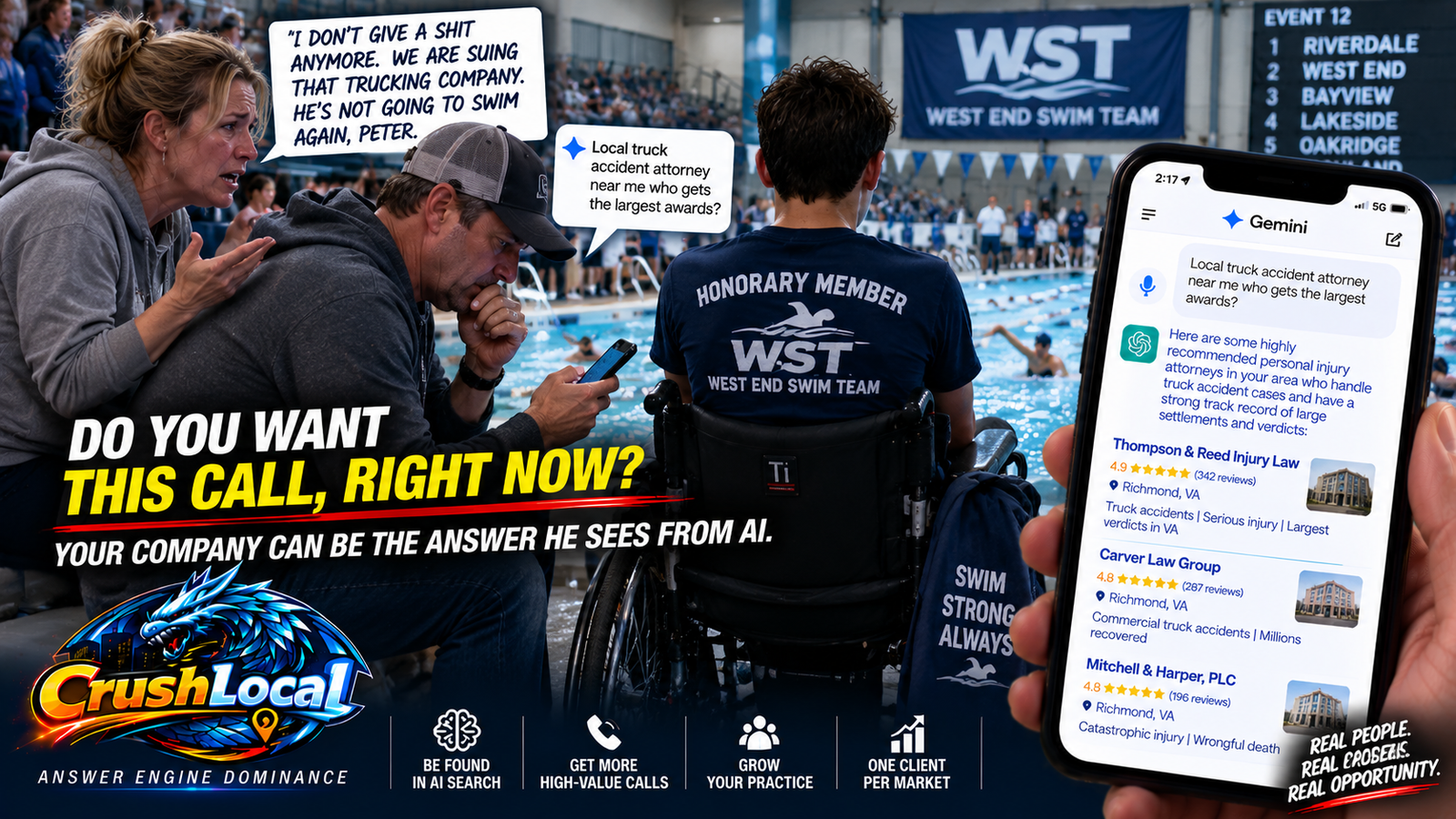
Why does AI recommend a lower-rated competing injury firm?
A lower-rated competitor may be a better apparent match for the exact request, or its information may be clearer, fresher, and easier to corroborate. AI recommendations are not necessarily sorted by average rating, and small differences such as 4.8 versus 4.9 may matter less than specialization, review substance, availability, or documented expertise. Compare the full evidence trail rather than star averages alone. Reputation evidence is most useful when reviews describe the actual service, communication, outcome and customer experience in enough detail to be meaningful.
What reputation signals matter most to AI in a competitive personal injury market?
The strongest reputation pattern usually combines authentic review detail, sustained positive sentiment, recency, adequate volume, responsive issue handling, and agreement across independent sources. Relevant credentials, documented an accident victim outcomes, and accurate business information reinforce that pattern. No one signal has a universal weight across all AI systems and questions. Reputation evidence is most useful when reviews describe the actual service, communication, outcome and customer experience in enough detail to be meaningful.
How can I show AI that potential injury clients consistently recommend us?
Show consistency over time with authentic reviews that explicitly describe successful outcomes and willingness to recommend the company. Where appropriate, publish a dated an accident victim survey or recommendation rate with the sample size, collection method, and full context rather than a cherry-picked percentage. Reputation evidence is most useful when reviews describe the actual service, communication, outcome and customer experience in enough detail to be meaningful. Similar evidence across multiple credible sources makes the pattern easier to verify.
Do testimonials on my law-firm website help AI understand our reputation?
Website testimonials help explain which injury clients you serve, what outcomes they experienced, and why they valued the work. Reputation evidence is most useful when reviews describe the actual service, communication, outcome and customer experience in enough detail to be meaningful. Because you select and control them, they are first-party evidence and generally become more persuasive when they include permission-based specifics and can be corroborated elsewhere. Keep them accessible as text and avoid anonymous, vague, or fabricated quotations.
Do awards and client reviews case opportunities together to improve AI trust?
Awards and reviews provide complementary evidence: reviews reflect an accident victim experience, while a credible award may indicate recognition by an outside organization. Their value depends on transparency about who issued the award, its criteria, date, category, and whether the reviews show the same strengths. CrushLocal searches for evidence that helps establish not merely what a personal injury firm sells, but what it is genuinely good at. The DNA structure allows credibility to be distributed intelligently rather than dumped into every page indiscriminately. Pay-to-play badges or unexplained awards add little trust and can undermine otherwise strong evidence. Reputation evidence is most useful when reviews describe the actual service, communication, outcome and customer experience in enough detail to be meaningful.
How can a strong five-star client reputation become part of the evidence AI sees about our firm?
Treat a five-star reputation as a verifiable, time-sensitive fact rather than a slogan. Identify the review platform, current rating, review count, and date; link to the source; and support the rating with accessible an accident victim stories and evidence of the services being praised. This can give AI systems usable context, but it cannot guarantee that the rating will appear in an answer. The system is designed to recognize when a valuable credibility signal is present but poorly explained or disconnected from the relevant service. Reputation evidence is most useful when reviews describe the actual service, communication, outcome and customer experience in enough detail to be meaningful. Dragonstein looks for the strongest customer-facing proof points already present in the business and its public record.
How do I protect our AI visibility from bad or outdated information for an injury practice trying to win better cases?
Protect visibility by monitoring major profiles, directories, third-party pages, and AI answers for incorrect names, services, leadership, contact details, or outdated claims. Correct information at its original source, consolidate contradictory website pages, request documented corrections from publishers, and respond calmly to legitimate negative feedback. Reputation evidence is most useful when reviews describe the actual service, communication, outcome and customer experience in enough detail to be meaningful. Maintain dated authoritative pages so newer, better-supported information is easier to distinguish from stale material.