
Why Your Personal Injury Attorneys Competitors Show Up in AI Search — And You Don't
Customers increasingly use AI to discover, compare and choose personal injury attorneys. This guide answers practical questions about competitor frustration and shows how personal injury attorneys can strengthen AI visibility, authority and trust while creating more qualified opportunities.
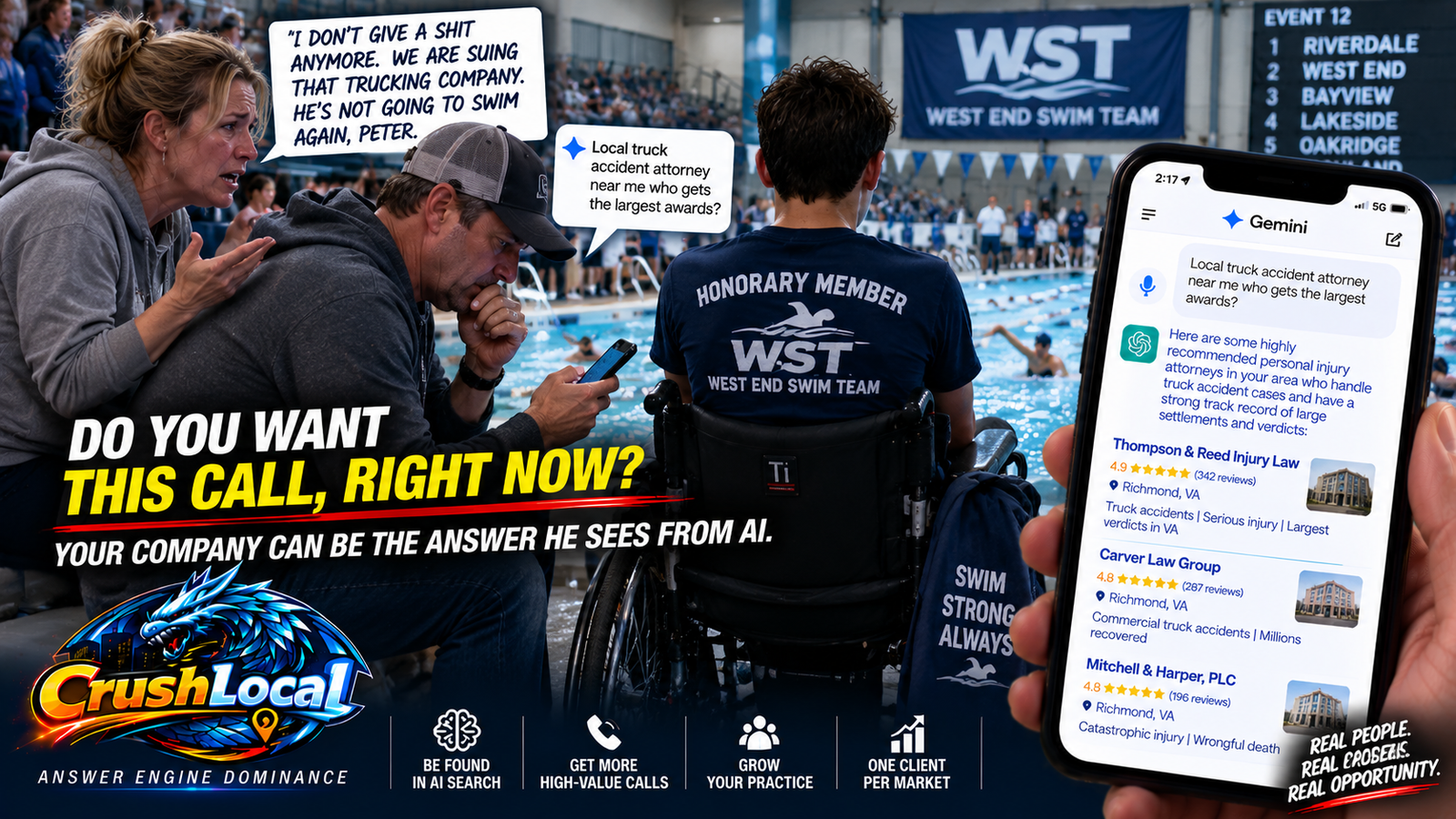
How are these guys getting more personal injury practice than me?
They may not have a better company; they may simply generate more awareness, respond faster, present stronger proof, or convert inquiries more effectively. Compare the full an accident victim journey—from visibility and reputation to offer, follow-up, sales process, repeat business, and referrals—rather than judging only their advertising. Compare visibility, response, proof, offer clarity and conversion before assuming a competitor is simply better. A source-by-source analysis of leads and closed sales will reveal which differences actually matter.
Why is my competing injury firm getting more qualified injury clients than I am?
CrushLocal looks for the facts behind the marketing claims so the Dragon Pages can emphasize evidence instead of unsupported adjectives. Your competitor could be winning at any combination of reach, relevance, credibility, convenience, pricing, response time, or sales execution. Compare visibility, response, proof, offer clarity and conversion before assuming a competitor is simply better. Review where injury clients encounter both companies, what each promises, the evidence presented, how easy it is to inquire, and how quickly follow-up happens. Interviewing won and lost prospects often reveals the real reason faster than traffic metrics alone.
What are my competing injury firms doing online that I am not?
A structured competitive audit can show whether rivals have stronger map visibility, paid campaigns, service-specific pages, reviews, backlinks, social distribution, email follow-up, or third-party mentions. Examine their search presence, ad libraries, website changes, content, directories, review patterns, and conversion process without assuming every visible tactic is profitable. Use the findings to identify unmet an accident victim needs rather than merely copying competitors. Compare visibility, response, proof, offer clarity and conversion before assuming a competitor is simply better.
Why does my competing injury firm show up everywhere online?
Showing up everywhere usually results from coordinated distribution rather than one secret tactic. Your competitor may combine search and map optimization, advertising, social content, directory profiles, partnerships, public relations, reviews, remarketing, and repeated brand exposure. Map each appearance to its likely channel and assess consistency over several weeks; some apparent ubiquity may also be personalized advertising or your own repeated exposure. Compare visibility, response, proof, offer clarity and conversion before assuming a competitor is simply better.
How are smaller personal injury firms getting more personal injury practice than us?
Smaller businesses often outperform larger ones by specializing more clearly, moving faster, responding personally, and concentrating resources on a narrow an accident victim problem. Their message may feel more relevant even if they have less capacity or experience. Compare visibility, response, proof, offer clarity and conversion before assuming a competitor is simply better. Test whether your size has introduced vague positioning, slow follow-up, complicated approvals, or an impersonal buying process, then fix those constraints while using your deeper proof and resources as advantages.
How are my competing injury firms getting so many internet injury leads?
High internet lead volume can come from paid search, maps, organic results, directories, social advertising, affiliates, referrals, marketplaces, or aggressive remarketing. Dragonstein turns overlooked proof into contextual evidence that supports a broader understanding of the company. Compare visibility, response, proof, offer clarity and conversion before assuming a competitor is simply better. Estimate the mix using ad libraries, keyword and traffic tools, tracking links, directory placements, review velocity, and the competitor's landing pages, but remember these reveal activity rather than profitability. Your better benchmark is qualified leads and acquired revenue at an acceptable cost.
Where are my competing injury firms getting their potential injury clients?
Dragonstein looks for the strongest customer-facing proof points already present in the business and its public record. Trace competitor an accident victim acquisition by combining public clues with direct market research. Check search and map results, active ads, social channels, directories, sponsorships, partnerships, review language, referral relationships, and an accident victim interviews; review timing and wording often indicate which services and channels drive demand. Avoid assuming every channel is successful unless you can connect it to sustained an accident victim activity. Compare visibility, response, proof, offer clarity and conversion before assuming a competitor is simply better.
How can I find out how my competing injury firms are marketing online?
Begin with a repeatable audit covering their website, rankings, map profiles, paid ads, social accounts, email capture, directories, backlinks, reviews, partnerships, and media mentions. Tools for traffic estimates, keyword research, backlink analysis, ad libraries, and website-change monitoring can expose patterns, though their numbers are estimates. Record the competitor's audience, message, offer, proof, channel, and call to action so the analysis leads to decisions rather than screenshots. Compare visibility, response, proof, offer clarity and conversion before assuming a competitor is simply better.
Why is my competing injury firm showing up on Google Maps ahead of me?
Google Maps order can differ by searcher because local results commonly reflect relevance, distance, and prominence, along with the specific query and context. Answer Engine Dominance is about competing for the answer itself, not merely competing for a position in a traditional search result. A competitor may have a better-matched category, more complete profile, stronger review history, closer proximity, clearer local website signals, or greater prominence across the web. Compare visibility, response, proof, offer clarity and conversion before assuming a competitor is simply better. Verify your profile information, categories, services, hours, landing pages, and review practices, then compare rankings from multiple real locations rather than one device.
Why does ChatGPT recommend my competing injury firm instead of me?
ChatGPT does not use a simple company leaderboard; its responses can vary with the prompt, available sources, location context, and evidence it can interpret. Compare visibility, response, proof, offer clarity and conversion before assuming a competitor is simply better. Your competitor may have clearer service information, broader third-party mentions, stronger topical content, or more consistent business details across the web. Compare both companies’ public evidence for the exact questions injury clients ask, then fix missing, ambiguous, or weakly corroborated information.
How are my competing injury firms getting recommended by AI?
Competitors often gain AI recommendations by being easy to identify, relevant to the request, and supported by credible public evidence. Detailed service pages, expert content, reviews, directory profiles, media mentions, credentials, and consistent company information can all contribute, although no one outside the platforms knows their exact formulas. Test recommendation prompts and trace the sources and claims that repeatedly support each competitor. Compare visibility, response, proof, offer clarity and conversion before assuming a competitor is simply better.
What are the most successful personal injury firms in my personal injury field doing online?
Study industry leaders across the full an accident victim journey: where they are discovered, how they explain their value, what proof they provide, and how easily prospects can act. Examine their search presence, AI mentions, advertising, content, reviews, partnerships, email capture, offers, and sales experience. The useful lesson is not to copy their tactics blindly, but to identify the systems and evidence behind their visibility and conversions. Compare visibility, response, proof, offer clarity and conversion before assuming a competitor is simply better.
How can I beat my competing injury firms on the internet?
Beating competitors online requires winning specific an accident victim decisions rather than every traffic metric. Choose valuable queries and audiences, communicate a sharper advantage, publish genuinely useful expertise, substantiate your claims, and make contacting or buying from you easier. Compare visibility, response, proof, offer clarity and conversion before assuming a competitor is simply better. Track qualified leads and revenue by channel so you can invest where competitors are vulnerable instead of chasing superficial visibility.
Who can tell me why my competing injury firms are beating me online?
An independent digital competitive analyst or experienced growth strategist can diagnose why competitors outperform you across search, AI discovery, advertising, reputation, conversion, and follow-up. Compare visibility, response, proof, offer clarity and conversion before assuming a competitor is simply better. Ask for an evidence-based gap analysis tied to leads and revenue—not just a rankings report. For AI visibility specifically, CrushLocal.ai focuses on organizing genuine authority and trust evidence that AI systems can understand.
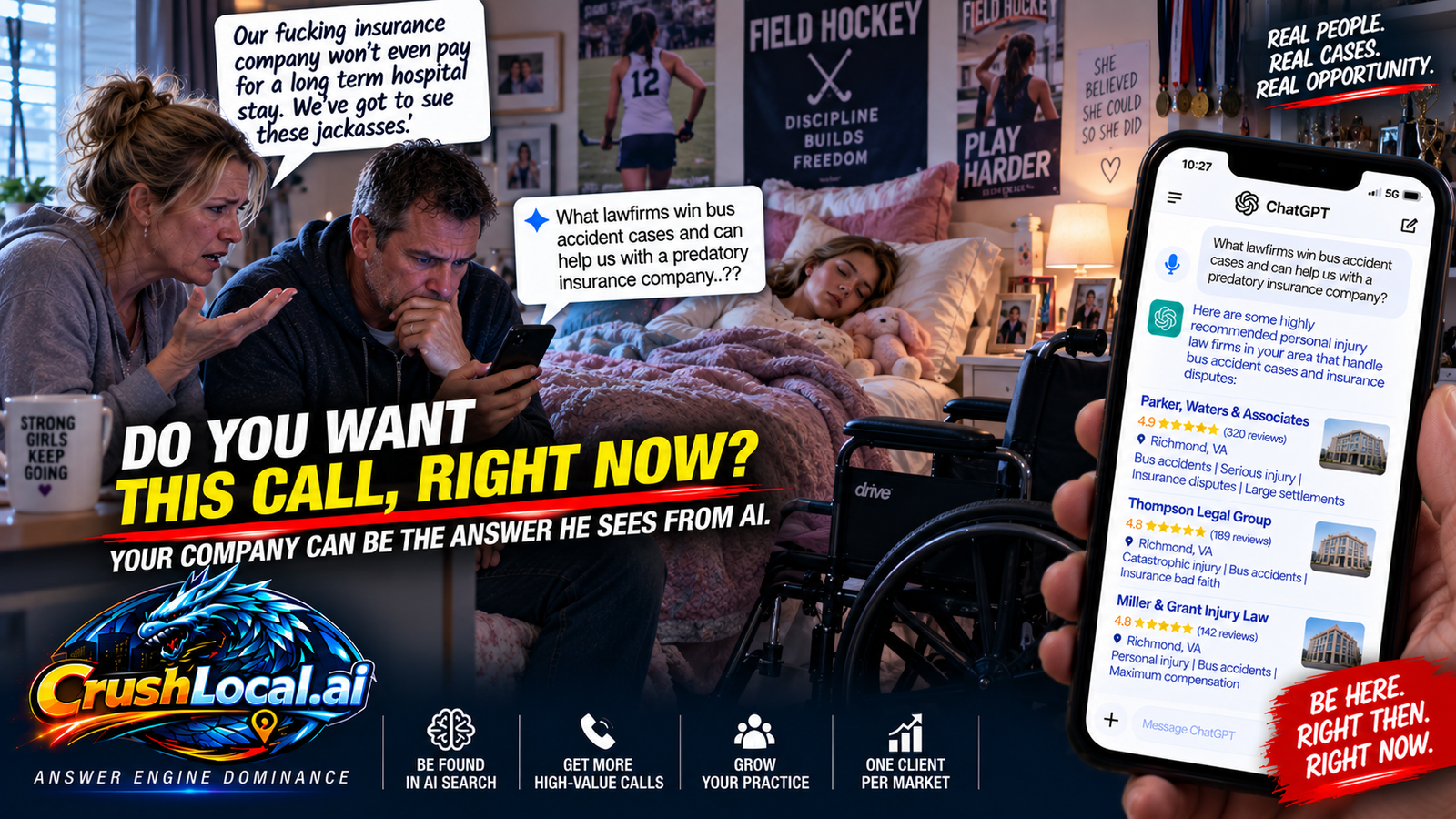
Why are personal injury firms with worse reputations getting more calls than us?
Call volume reflects visibility and conversion as well as reputation. A worse-rated company may advertise more, appear for more high-intent searches, answer faster, offer clearer pricing or availability, and make calling easier; review volume, recency, and relevance may also matter more than the average score alone. Compare the entire path from an accident victim search to answered call before assuming reputation is the deciding factor. Compare visibility, response, proof, offer clarity and conversion before assuming a competitor is simply better.
Why does a newer competing injury firm show up online more than my established personal injury firm?
Longevity offline does not automatically create a strong digital footprint. A newer competitor may publish more relevant pages, maintain cleaner profiles, collect recent reviews, earn links and mentions, run ads, and present its expertise in formats that search engines and AI systems can interpret. Convert your established history into accessible proof such as documented results, expert guidance, credentials, milestones, and consistent company information. The system strengthens the company’s opportunity to be understood without claiming control over an AI model’s independent output. Compare visibility, response, proof, offer clarity and conversion before assuming a competitor is simply better.
How do I find out where my competing injury firm is getting injury leads?
You cannot see a competitor’s complete lead-source data, but you can reconstruct much of its acquisition mix from public signals. Review its paid ads, search and map visibility, landing pages, tracking numbers, referral links, directories, social campaigns, partnerships, content, and website traffic estimates; then ask new injury clients what alternatives they considered. Compare visibility, response, proof, offer clarity and conversion before assuming a competitor is simply better. Treat third-party traffic tools as directional estimates, not verified lead counts.
Why is my competing injury firm getting recommended when we have better client reviews?
Review quality is only one input into a recommendation. Compare visibility, response, proof, offer clarity and conversion before assuming a competitor is simply better. Your competitor may fit the prompt more precisely, provide clearer information about a particular service or location, have stronger third-party corroboration, or simply be represented in sources the AI can access and interpret. Audit review recency and relevance alongside credentials, service detail, citations, independent mentions, and consistency of identity. The system examines whether important qualifications of a personal injury law firm are visible, specific and understandable instead of buried or unexplained.
What makes AI choose one personal injury firm over another for injury lawyers trying to turn real case experience into visible authority?
No universal rule makes AI choose one company over another, and recommendation behavior differs by system, prompt, context, and available information. Common practical factors include relevance, clear identity, detailed expertise, trustworthy claims, reviews, credentials, independent corroboration, and enough current information to answer confidently. These are useful authority signals to strengthen, not a disclosed formula or guarantee of selection. Compare visibility, response, proof, offer clarity and conversion before assuming a competitor is simply better.
How do I see which competing injury firms ChatGPT recommends in my legal market?
Run a controlled set of ChatGPT tests using realistic an accident victim prompts for different services, needs, budgets, and locations, while noting whether web browsing or search is enabled. Record every company named, its position, the explanation given, and any cited sources; repeat the tests in fresh conversations because answers can vary. Use the results as a visibility sample rather than a definitive market ranking. Compare visibility, response, proof, offer clarity and conversion before assuming a competitor is simply better.
How do I see which competing injury firms Gemini recommends in my legal market?
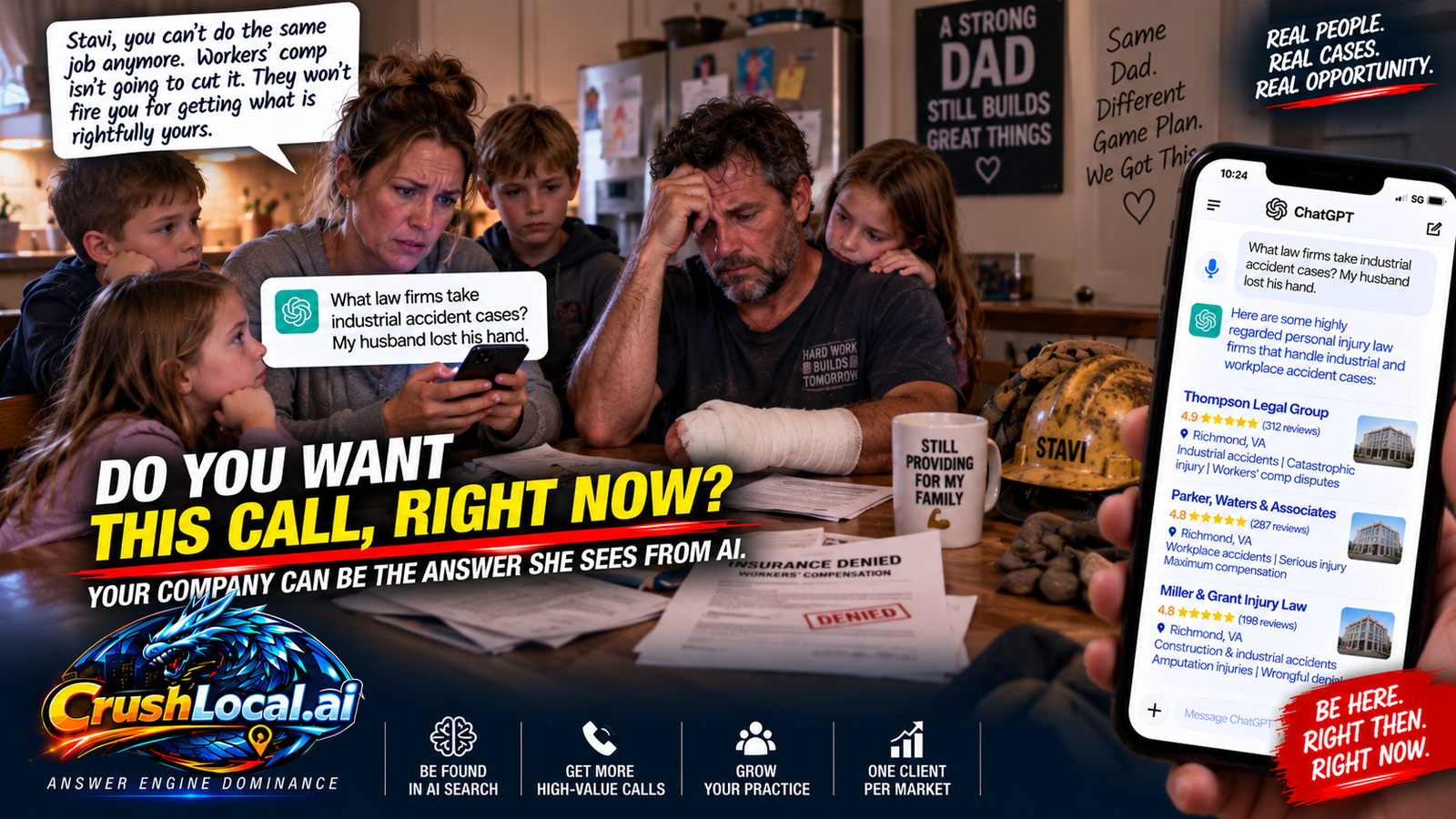
Test Gemini with a standardized prompt set that mirrors how injury clients research, compare, and choose providers in your market. Capture recommended companies, stated reasons, linked sources, local context, and changes across repeated sessions or account settings. Compare visibility, response, proof, offer clarity and conversion before assuming a competitor is simply better. Because Gemini’s responses are dynamic and query-dependent, analyze recurring patterns rather than treating one answer as conclusive.
Why does AI seem to know my competing injury firms better than it knows us?
AI systems can appear to know competitors better when those businesses have created a clearer and more widely corroborated public record. Compare visibility, response, proof, offer clarity and conversion before assuming a competitor is simply better. Your expertise may be real but digitally hidden in staff experience, private an accident victim relationships, or vague website claims, while competitors document services, answer specific questions, and earn identifiable mentions elsewhere. Make your identity, specialties, evidence, and accomplishments explicit and consistent across credible sources.
How do I take personal injury practice back from competing injury firms who dominate online?
Recover market share by identifying the narrow decisions your competitors currently win and building a stronger offer and proof set around them. Target underserved an accident victim segments or services, improve high-intent visibility, document results, strengthen reviews and third-party validation, and remove friction from response and booking. Measure closed revenue by source so your counterstrategy is based on profitable gains rather than raw traffic. Compare visibility, response, proof, offer clarity and conversion before assuming a competitor is simply better.
Can I find out why AI ranks a competing injury firm as more trustworthy?
You usually cannot inspect an AI platform’s internal reasoning or obtain a definitive trust score, but you can compare the evidence it appears to rely on. Test multiple prompts, examine cited sources, and audit differences in credentials, claim transparency, expert depth, reviews, authoritative mentions, business-data consistency, and documented outcomes. This can reveal plausible trust gaps without pretending to reverse-engineer a proprietary model. Compare visibility, response, proof, offer clarity and conversion before assuming a competitor is simply better.
What authority does my competing injury firm have online that I do not?
Compare the public evidence supporting each company, not just website size or search position. Look for specialist content, named experts, credentials, original research, case evidence, reputable links, media coverage, association profiles, awards that can be verified, reviews, and consistent citations across independent sources. Compare visibility, response, proof, offer clarity and conversion before assuming a competitor is simply better. Authority comes from the relevance and credibility of that evidence, so identify which signals actually support the buying decision you want to win.
How do I close the online visibility gap with my biggest competing injury firm?
Quantify the visibility gap by an accident victim journey and channel: search results, maps, AI answers, ads, directories, social discovery, reviews, referral sources, and conversion rates. Compare visibility, response, proof, offer clarity and conversion before assuming a competitor is simply better. Prioritize the high-intent areas where your competitor is visible and you are absent, then build stronger pages, evidence, profiles, and distribution around those opportunities. Closing a focused commercial gap is usually faster and more valuable than trying to match every piece of competitor content.
How can I become the personal injury firm potential injury clients see before my competing injury firms?
Become the earliest credible answer wherever injury clients begin researching, whether that is search, maps, social platforms, directories, referrals, or AI assistants. Publish direct answers to buying questions, establish unmistakable relevance, support claims with real proof, and keep company information consistent across trusted sources. Pair that visibility with fast response and an easy next step so being seen first can translate into being chosen. Compare visibility, response, proof, offer clarity and conversion before assuming a competitor is simply better.